
Hills joins industry task force
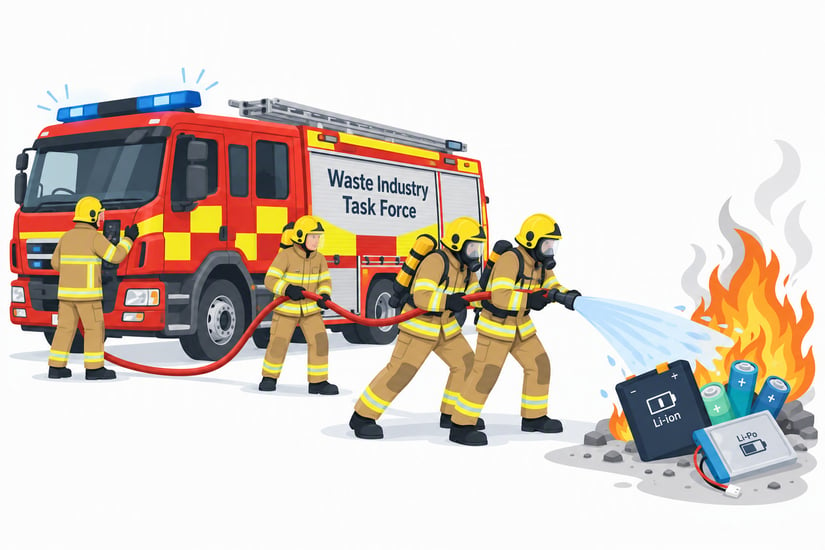
Hills joins industry task force tackling battery fires in the waste sector
Hills Waste Solutions is playing an active role in a new industry task force bringing organisations together to tackle the growing problem of battery fires in the UK’s waste and recycling sector. The Battery Fires Task Force has been established by the Environmental Services Association (ESA), the voice of the UK’s recycling and waste treatment sector, to bring together expertise from across the waste industry, government, regulators and organisations involved in batteries and electrical products.
Hills Waste Solutions is represented on the Task Force by Managing Director Neil Pollard, who took part in its first summit in London on 18 November. Representatives from across the waste and recycling sector were joined by organisations including Defra, the Environment Agency, the National Fire Chiefs Council, Material Focus and Electrical Safety First.
A growing challenge for the waste industry
Battery fires have become an increasingly significant issue for waste and recycling operators. Lithium-ion batteries can be found in an ever-growing range of everyday products, from mobile phones and electrical devices to e-cigarettes. If batteries or products containing them are incorrectly placed in general waste or recycling, they can become damaged during collection and processing, creating a serious fire risk.
Figures highlighted by the ESA show the scale of the challenge. More than 1,200 battery-related fires occurred in refuse vehicles or waste facilities during 2023/24, representing a 71% increase on the previous year. The impact can extend well beyond the fire itself, potentially putting waste operatives and firefighters at risk while damaging vehicles and facilities, disrupting services and creating wider financial and environmental consequences.
Turning shared experience into practical action
The first Battery Fires Task Force summit focused on how organisations across the sector can work together to reduce the number and severity of battery-related fires. Discussions centred around four key areas: improving the evidence available on battery fires; preventing batteries from entering the wrong waste streams; finding better ways of detecting and intercepting batteries during waste processing; and improving fire prevention and mitigation.
Among the ideas receiving support were the development of a national battery-fire incident reporting system, a coordinated behaviour-change campaign, sharing operational best practice across waste facilities, and developing more consistent approaches to fire prevention.
Neil Pollard, Managing Director of Hills Waste Solutions, said:
“Battery fires are a very real challenge for our industry and one that no single organisation can solve on its own. We see the risks that incorrectly disposed batteries can create, so bringing together knowledge and practical experience from across the sector is an important step forward.
“Hills is pleased to be involved in the Task Force. I’m looking forward to contributing our operational experience and working with colleagues from across the industry to identify practical measures that can make a genuine difference.”
Working together to reduce battery fires
There is unlikely to be one simple solution to battery fires. Prevention, public awareness, collection systems, technology and effective fire mitigation all have a part to play. That is why Hills welcomes the collaborative approach being taken by the Task Force. Its aim is not simply to discuss the problem, but to develop a practical work programme, with an ambition to have two or three significant projects underway by mid-2027.
For Hills, participating provides an opportunity both to share the experience gained from our own waste and recycling operations and to learn from others across the sector.
We look forward to playing our part as the Task Force moves from its first summit towards practical action.
Find out more: Visit the ESA and find our more about its battery-fire campaigning work.